
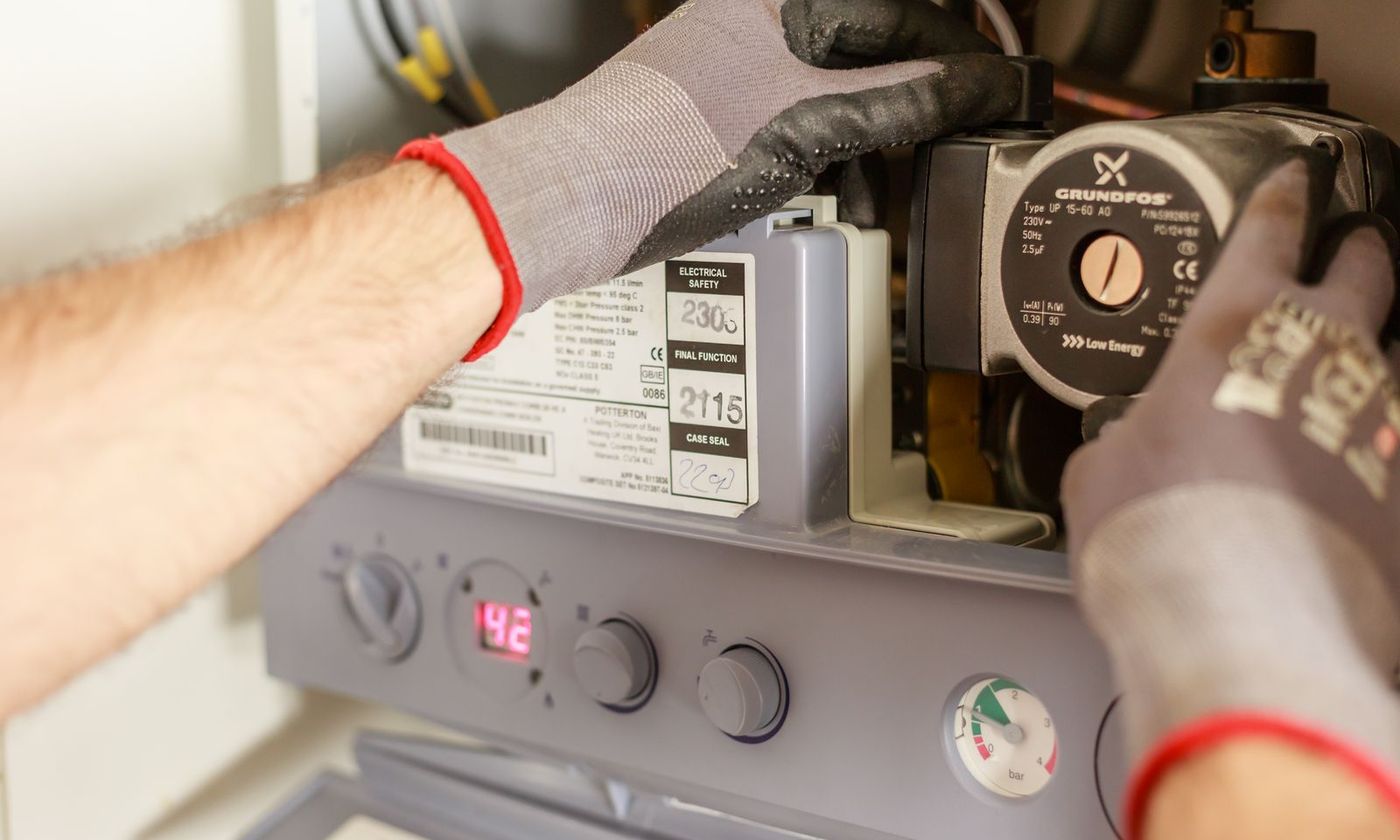
Why tankless faults look different
A storage tank keeps a reservoir of hot water. A tankless unit keeps none — it senses flow, fires a burner, and heats water as it passes through a heat exchanger. That means faults present as behaviour rather than absence: the temperature wanders, the burner short-cycles, or the unit locks out and displays a code.
Nearly every tankless heater self-diagnoses. The code on the display narrows the fault quickly, which makes these units faster to diagnose than tanks once you can read what they are reporting.
Common faults
Scale in the heat exchanger
The most frequent tankless problem. Mineral scale coats the exchanger, restricts flow and forces the burner to work harder, eventually triggering overheat or flow-related lockouts. Resolved by descaling through the isolation valves — not by replacing parts.
Flow sensor and minimum activation
Units need a minimum flow rate before they fire. A fouled flow sensor, a partly closed valve or an aerator clogged with debris can push a fixture below that threshold, so the burner never lights for small draws.
Ignition and flame sensing
Igniter wear, a dirty flame rod, or a gas supply that cannot hold pressure under the unit's high demand all produce ignition-failure codes. Tankless heaters need far more gas volume than tanks, so an undersized gas line is a genuine cause.
Venting and air supply
Most units use sealed, direct-vent systems. Blocked intakes, disconnected joints, or a vent terminal too close to an obstruction cause combustion and exhaust faults that the unit reads as an air-supply error.
The cold water sandwich
A burst of hot, then cold, then hot again at the start of a draw is normal tankless behaviour rather than a fault: it is the residual hot water in the pipe, followed by the gap before the burner reaches temperature. It becomes a complaint when it is severe, which usually points to a recirculation problem or a unit sized wrong for the fixture pattern. That is worth diagnosing rather than living with.
Annual descaling matters more here
Tank heaters tolerate neglect for years. Tankless units do not — scale accumulates directly on the exchanger surface and is the leading cause of premature failure. Units installed with isolation valves can be flushed without cutting any pipe.
Repair or replace
Heat exchangers are the expensive component, and a cracked exchanger on an out-of-warranty unit usually ends the conversation. Almost everything else — igniters, flame rods, flow sensors, fans, control boards, gas valves — is a serviceable part. Tankless units also last considerably longer than tanks when they are descaled, so repair is more often worthwhile than it would be on a fifteen-year-old storage heater.
Tankless in Wilmington homes
Tankless conversions are common in Wilmington's renovated rowhomes, where a wall-hung unit frees up basement floor space, and in newer construction through Brandywine Hundred and Talleyville. In retrofit installations the two things that most often cause ongoing trouble are a gas line carried over from the old tank without being resized, and a vent run that was pushed past its maximum equivalent length. Both show up as intermittent lockouts rather than outright failure.
If you are weighing a tankless unit against a conventional tank, the comparison against a straightforward tank replacement depends heavily on your existing gas and venting, not just on the appliance.
Related repairs
- Water heater not heatingLukewarm water, short supply and slow recovery on any fuel type.
- No hot water repairComplete loss of hot water on gas, electric and tankless systems.
- Water heater noise repairPopping, rumbling, banging, ticking and screeching — matched to their cause.
- Water heater replacementTank and tankless replacement, correct sizing, venting and code compliance.
Questions we get asked
What does the error code on my tankless unit mean?
Codes are manufacturer-specific but group into families: ignition failure, flame loss, overheat, air supply or exhaust blockage, flow sensor, and internal control faults. Having the code and the model number ready when you call makes the first visit far more productive.
How often should a tankless heater be descaled?
Annually is the usual interval, and more often where supply water is hard or the unit runs heavy daily demand. If the unit was installed with isolation valves, the flush is straightforward.
Why does my tankless heater not fire for a small trickle of hot water?
Every unit has a minimum activation flow rate. Below it, the burner will not light by design. If that threshold seems to have crept up, the flow sensor or an inlet screen is usually partly fouled.
Can a tankless unit run out of hot water?
It will not run out, but it can fall behind. If demand exceeds the unit's flow rating — two showers plus a dishwasher, for example — output temperature drops. That is a sizing limit rather than a fault.
Get it looked at
Describe what the heater is doing when you call — the symptom usually narrows the fault before anyone arrives.
(302) 603-9708 Call now for service